The Gilmore Girls Reading List

Sunday, 12 August 2018

Anomaly by Krista McGee


Published: 2013
Publisher: Thomas Nelson /Audible
Author's Website
Format: Audiobook, Unabridged
Series: Anomaly
Narration by: Hayley Cresswell

Introduction

Thalli lives in Pod C, designed by scientists to be a musician. She and her pod mates live in an underground society because nuclear war has decimated the surface. Their society is very rigid and rational. Emotions are to be regulated. Questions are not to be asked. Love as a concept and feeling has been abandoned. Anyone who exhibits these traits are anomalies and must be annihilated. Thalli has avoided suspicion for all her life. Now that she is 17, it is harder. When she begins to cry uncontrollably, the scientists to label her as an anomaly to be disposed of. Desperate not to die, she and her childhood friend, Berke, try to prove her unusual character to be useful to their society.

Genre-Christian Fiction

I didn't realize it is Christian fiction until the talk about the Creator came in, and it was lightly spoken of at first. Goodreads has it tagged as Christian Fiction, so if you are interested in the genre, here's a Christian fiction, sci-fi, dystopian YA. Towards the end of the novel it got a bit heavy and it honestly dragged on and on when it really didn't need to. It might be a turn-off for some readers, but I thought the mixing of "science is the only way" and religious belief was interesting. 

Writing

The writing is bland, and that's being generous. The world they live in is devoid of emotion and frivolous ideas like fancy words. It makes sense that everyone speaks without contractions and they are very "to the point". But even Thalli at her best is a white-bread experience. I am so very certain the writing style is very intentional given the world, but the reader has to enjoy reading the book. I listened to this as an audio book and all the dialogue and Thalli's descriptions came off as so stilted.

Also, the writing about the Thalli's brain and conscious vs unconscious thought and music was going to solve all of their problems...that was silly. I couldn't suspend my disbelief to think that the resident musician was going to solve the problem the scientists couldn't solve.


Twists 

Most of the surprise twists were awful. Laughably awful. Yes, question the scientific society and you'll catch them in some lies. But the ridiculousness piled up and they were unbelievable. I don't want to spoil the book if someone actually wants to read this, but once you do read it, you'll know what I'm referring to (pretty much everything).


At first, I finished the book and was relieved the experience was over. Then I hop on to Goodreads and see this is a trilogy. This. Has. More. Books. White Bread: The Sequel. White Bread: The Conclusion. I doubt I'll listen to or read the others, but...maybe. Why? I also disappoint myself.

Final Thoughts

If you like Christian fiction, YA, sci-fi, and dystopias, I can see why this may interest you. I haven't read much Christian fiction, so I can't recommend anything in its place. However, this is a hard sell for me. The sci-fi portion of it was so disappointing. The twists that take place were ridiculous and unbelievable. The ending was a dumpster fire. I don't recommend this, unfortunately. It has, however, made me realize I should read and review Christian fiction so I can recommend some titles if a library patron ever asks.


*I don't have a problem with white bread, I really don't. I just don't want a book printed on it.


The Book of Ivy by Amy Engel

The Book of Ivy

Published: 2014
Publisher: Entangled: Teen/Audible
Author's Website
Format: Audiobook, Unabridged
Series: The Book of Ivy
Narration by: Taylor Meskimen

Introduction

50 years after a nuclear war, survivors in the United States rebuild. Conflict regarding leadership arose between the Lattimers and the Westfalls. The Westfalls were defeated. In their post-apocalyptic world, the two families have "shared" leadership, with the Westfalls as figureheads of goodwill with no power. A major premise of their society is forced marriages between the two sides of town-the "good side" (Lattimers) and the "bad side" (Westfalls). Every year, teenagers (from each side) are paired off with opposition by the government and take on traditional gender roles. Men work, women have babies and clean the house. The Lattimers and Westfalls must marry their children to each other, age and gender permitting. This year, Ivy Westfall must marry Bishop Lattimer, but her father and sister Callie have something more planned for her. To overthrow the government, Ivy is tasked to kill Bishop. It's step one in her father's plan to rid them of their operssive rulers.

Story

The premise of the story is a question: Can Ivy kill Bishop? I assumed the simple answer would be this:


Turns out, it's a little more complicated. First, can she kill anyone? And how can she kill a boy she doesn't know, but is getting to know? The book is a love story, though we've seen it a thousand times.

As the story progresses, there are some interesting twists I didn't see coming. Like most dystopias, the characters come to realize that they had been lied to, to some degree. Ivy questions everything and tries to remain a good person, and the struggle was engaging.

Essay Idea: Government Control & Enforced Gender Stereotypes

Could easily pair this with A Handmaid's Tale by Margaret Atwood. The government makes you marry someone of their choosing. The government is not elected. Men go to work, women have babies. These unions are not always happy or safe. Ivy is keenly aware of the threat of domestic violence.

Dissent is not an option. If you do commit a crime, such as refusing to enter into an arranged marriage, you are put outside of the wall that surrounds their settlement, and you are left alone. Cast out with no water, food, or shelter, you have to fend for yourself in an unknown landscape.

Bishop's Character

I was surprised that I liked Bishop so much. Spoiler alert: he's not like his parents in SO MANY WAYS. Kind, but wow, he's not afraid to dish out punishment when he sees bad things happening. I find a lot of YA men are bland and one dimensional. Time and effort were put into his character, and I appreciate it.

Final Thoughts

I recommend this to teens who like dystopias, gender roles, and oppressive governments. There is only one more book in this series, so it's great for readers who don't want to read seven books to get the ending. There could have been more world-building, but I suspect that the second book will cover that, given the circumstances. 

I have something to say about the ending, so if you haven't read it, skip the rest of the post. 


Ending Spoiler

What did she think Callie would do?! Plus...I don't like how she opted to have herself ejected from society rather than choose a side. At the very least, I thought she'd give Bishop a heads-up (you know, DON'T TRUST CALLIE!) but she didn't. That was anticlimactic.    


Memoirs of a Geisha by Arthur Golden -- Essay/Discussion Ideas


Published: 1997
Publisher: Vintage Books USA
Author's Facebook
Goodreads Page

Introduction

Sayuri was brought from a small fishing village to become a geisha--an artist who entertains men. Early on, he falls in love with the Chairman. Part of being a geisha is not loving at all, but Sayuri is determined to have something with him. As her position in Gion rises with her perseverance, WWII is approaching, threatening everything she has worked for.

Authenticity 

There was much discussion regarding whether or not the book is historically accurate or a truthful description of geisha life. The following post is not going to focus on the truthfulness of this historical fiction/fictional memoir but as a launching point for essay/assignment ideas. When I was in high school taking an AP literature class, a student was tasked with comparing it with another book, and I believe it was Three Cups of Tea, which also has a scandal regarding its authenticity (see Three Cups of Deceit).


Essay Idea: Sexualized Orientalism/Women as Sexual Objects

"Golden treated Japanese culture and geisha as an object to be sexualized, exoticized, and romanticized." Orientalism and the Binary of Fact and Fiction in Memoirs of a Geisha, Kimiko Akita.

Despite trying to pound into the reader that geisha are not prostitutes, the sexualization and exchange of money are hard to ignore. They are educated young women, and still, their bodies are treated as marketable. Portions of the book are focused on how much flesh can be displayed to whom, and when. The end game of some geisha is to become a wealthy man's mistress (which can be seen as a prostitute attached to only one man). Hatsumomo's downfall accumulated with her probably becoming a prostitute, which is portrayed as negative. The conflicting ideology is tough to swallow. The label of prostitute is the absolute worst, yet the height of their careers is when they can exchange sex for money. A geisha's sale of her virginity is probably the highlight of her career, and people remember the sums they bring in.

The book depicts children/women as a burden. They are sold and whisked away to the city, where they become geisha or prostitutes (in the book, there's no mention of other possibilities, such as factory work, maids, etc.). When they do not earn as much as they used to, they are no longer valued and are seen as another mouth to feed (Hatsumomo). Hatsumomo and Pumpkin can be viewed as the outcome of such a life of exploitation. 

See more here.

http://www.worldhistoria.com/oiran-vs-geisha_topic124658.html

Essay Idea: Book VS Film

The film, in my opinion, focused too much on the scenery than on being a good film (but it was a gorgeous film!). Characters aren't introduced properly, and I'd wouldn't be surprised if viewers were confused. In the book, Sayuri pursues men of her own choosing (aside from the constant pursuit of the Chairman). In the film, she does not pursue men other than the Chairman (which can be read as predatory, as he was a married adult when he met her, and she was 12). There are a plethora of differences that can be discussed.


Essay Idea: Truth of the Geisha, Golden VS Iwasaki

This book was written by an American. He does have some impressive credentials, including a degree in art history (specializing in Japanese art) from Harvard, and a M.A. from Columbia University in Japanese history. He had to ask some geisha to break their secrecy for this novel, and apparently, Mineko Iwasaki asked to not be named...which he did. In the back of the book, he thanked her, which cause a scandal in the current geisha world. She has since released her own memoir (Geisha, a Life), as it is contested by many that Memoirs of a Geisha has a lot of misinformation. A compare and contrast of the books' geisha would be interesting (as of writing, I have not read Iwasaki's book, I am waiting for it to arrive).

It has been purposed that perhaps he conflated oiran with geisha. They were in the pleasure districts and it seems that Golden's geisha are a mixture of oiran and geisha.

http://villains.wikia.com/wiki/Hatsumomo
Essay Idea: Changing Japan

The book gives some details about how Japan was changing before, during, and after WWII. If you like history, you can write about the Great Depression and the American Occupation. How were they affected in Gion, or were they sheltered? What about the traditions they held on to, or tried to hold on to?


Essay Idea: Female Characters & Identity

This book is full of women, both good and bad. Ultimately, they all seem to scheme, one way or another, to survive in their world. Who survives by being strong and independent, and who submits to the oppressive system to get by? Why doesn't Hatsumomo make it?

(In the reverse, it seems that all men are creeps, even, IMO, the Chairman. What does that say in the narrative, as it relates to the women?)

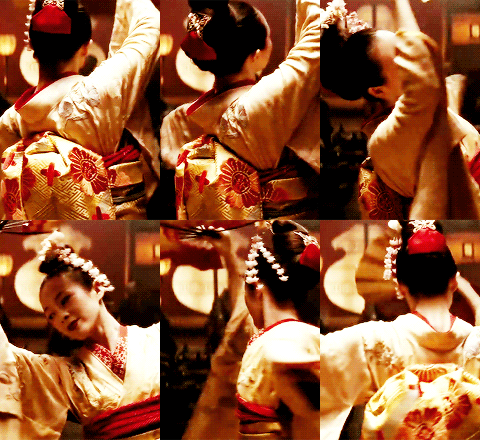
Also, the concept of identity is interesting in this book. The female geisha characters are born with one name (Chiyo), and when they become geisha, they get a name that usually connects them with their mentor (Sayuri). If they are adopted by their okiya, they get the family name (Nitta) as well. Sayuri narrates her life, and her older persona seems to have a new identity as well, detached from her former selves. Geisha have elaborate hair and makeup, masking them, shielding them, making them a fantasy. Their kimono give them an unnatural cylinder shape that is difficult to walk in. The obi of their kimono have to be tied by men. With the help of men, and for men, they have to shift their identities. (Unless men are adopted for business reasons, they never change their name.)

Perhaps shifting identities is the only way for these women to survive their society. Perhaps they needed it because just being a regular woman in society was a dangerous feat.   
 

Essay Idea: The Translator's Note?

The beginning of the novel starts with a translator's note, which is just Golden framing the narrative. What does this add? Authenticity, especially when the book's truthfulness is questioned? A buffer for misconceptions? The book isn't really a memoir either.


And this is all I have come up with. Please let me know if any of this was helpful! This blog gets hits but I rarely get comments anymore, so I feel like I am screaming into the void here.  

Thursday, 9 August 2018

Dawn of Eden by Julie Kagawa

Blood of Eden

Published: 2013
Publisher: Harlequin Enterprises, Ltd/Audible
Author's Website 
Format: Audiobook, Unabridged
Series: Blood of Eden
Narration by: Thérèse Plummer

Introduction

This is the prequel to The Immortal Rules. It follows a new character, Kylie, and returning character Ben Archer as they attempt to survive the early days of the epidemic. 

Not Really YA?

First, the two protagonists are in their 20s, in their careers, and away from parents. They are established adults. 

Second, there is also some graphic sex in the middle of the book that I found really off-putting, especially as I listened to this audiobook while running in a park. Why do this when the other three books are YA? Goodreads has this listed as YA as well, and I can't agree. It was so detailed and it went on forever. It is by far the most graphic scene of its kind I've encountered in "YA" thus far. 

Final Thoughts

It didn't add anything to the other entries in Blood of Eden. In the beginning, Kylie is indistinguishable from Allie. If I were a library purchaser, I'd probably just skip it, unless you have die-hard fans, which is unlikely now, as the series is old and finished. This isn't YA, where would you put it? Away from the rest of the series in the regular fiction? Nah, not worth the trouble.


Monday, 30 July 2018

The Forever Song by Julie Kagawa

Blood of Eden

Published: 2014
Publisher: Harlequin Enterprises, Ltd/Audible
Author's Website
Format: Audiobook, Unabridged
Series: Blood of Eden
Narration by: Thérèse Plummer

Introduction

Zeke is dead, and Allie, Kanin, and Jackal are still travelling to stop Sarren. Allie has decided that with Zeke dead, she hates everything, and she wants to be a monster now. Jackal approves. Kanin isn't mad, he's disappointed.

Weak Female Protagonist

First, this book waxes sentimental WAY too much. I wish my music app on my phone had a "skip ahead 10 seconds" button like Youtube.

Overall, Allie is a weak protagonist in this book, which is the exact opposite of what she once was. People do change, sometimes for the worse, but this seems like bad writing. Instead of saving the world, she decides to go after her love interest. You know, after saving the world, he will STILL BE THERE. Saving the world is more important. Too many times she should have waited for the other two members of her team to come, but she rushed into danger and made everything worse. I guess the power of lub <3 is detrimental to strong women.

Sacrifice Ending

That was so lazy and just a dramatic gimmick. I'm pretty sure you could have sprayed your blood on them and gotten the same effect. You're a vampire, and we know limbs regenerate. Toss them an arm!


In my headcanon, he didn't die. He decided to get a hobby, like golf, and he took some time off to be by himself, away from the trio of idiots he had to spend last 6(ish) months with.

Final Thoughts

Despite Allison's terrible decision-making abilities, I still recommend this book. The trio has a nice family dynamic to it that was hilarious to listen to. If you've read the first two books in this series, or if your library has purchased the first two, there isn't a reason to not have the final book in the series in your collection. I recommend this to anyone who enjoys paranormal fiction, dystopias, vampires, or horror.

Thursday, 26 July 2018

Xbox One Adaptive Controller -- Library Tech

Does your library have a gaming program? Have an Xbox One?

Microsoft has announced an adaptive controller, and libraries may benefit from having a few available.


Back in May, it was announced, and recently we heard that even the box is accessible. The base controller (above), can be connected to more peripherals (there are 19 jacks in the back), such as joysticks, pedals, and finger switches. The base controller doesn't come with these extra peripherals, but I think this is a strong step in the right direction. It releases sometime this year (2018), and I'll be looking to see if any libraries utilize it, and the outcome.

Wednesday, 25 July 2018

The Eternity Cure by Julie Kagawa

Blood of Eden

Published: 2013
Publisher: Harlequin Enterprises, Ltd/Audible
Format: Audiobook, Unabridged
Series: Blood of Eden
Narration by: Thérèse Plummer

Introduction

At the end of the last book, Allison is alone again. Now, she is looking for her maker, Kanin, following the blood bond. Around her rises a new strain of the Red Lung virus that is fatal to both humans and vampires. Her journey leads her to reunite with those she never expected to see again. She gains unexpected allies and new missions: save Kanin, find the cure, and stop Sarren. Allison fights her own inner monster to remain as human as possible, despite being told it's impossible. 

Returning Characters

I appreciated the recurring characters. I find that too many authors are quick to add new characters in every book when there are already established characters at the ready. The characters that showed up here worked very well and I was glad to see them all again (with one exception, I was hoping he was gone). There's a comic relief character that was so very needed.

Book about Walking

Like the Lord of the Rings or The Hobbit, a lot of this book is walking. Gets a little boring, but I think the banter and the events that happen from point A to point B make up for it. Based on the world they live in (usually no access to functioning cars), it's understandable.

Different Book Covers

Seems that this book some different covers. The one above is nice, but it doesn't match the previous cover, which means that your books aren't going to match. I'd get the covers to match, personally.


Final Thoughts

The sequel did not disappoint. If you have the first one in your library collection, nothing is keeping this from anyone's collection.


Sunday, 15 July 2018

The Rest of Us Just Live Here by Patrick Ness

Published: 2015
Publisher: HarperTeen
Author's Website

Introduction

There are indie kids, the kids who are special, the Chosen One(s). They have destinies. Their lives are full of extraordinary occurrences, tragedy, and love. And they always save the day. But what about the rest of us? The teens that go to high school and the adults and their jobs? What happens when you blow up the school, kill all the vampires or zombies, and many of your classmates and friends go missing? With all the storylines swirling around them, what is everyone else up to? Not surprisingly, they have lives too, affected by the chaos, their own problems. A politician mom, a struggling father, mental health issues, sexual orientation, college admissions, prom--all problems that these background characters deal with. A satire of young adult literature in a familiar world afflicted with over-the-top end-of-the-world situations.

Chapter Introductions and Section Dividers

https://patrickness.com/wp-content/uploads/2015/08/TROUJLH_9781406331165_PI_UK-extract.pdf  
Every new chapter gives a summary of what the indie kids are doing. At first, I didn't like it, but the two stories intermingled a bit and it was great. This is the forefront story, but this book is centred on the teens in the background. It would have been a bit confusing if we had no idea what the indie kids were doing. Plus, at times, it was funny. Above, we hear that there's more than one indie kid named Finn (of course), and a girl named Satchel. Reminds me how books and films influence baby name trends (all those Edwards!).

The section dividers are occasionally these cats, and I love them:

+1 to this book.

Worst Character Award

Henna.

People make mistakes (and all of the characters in this book make mistakes) but I found myself consistently disliking her. I feel bad because, in the back of the book, we hear that her name is from a real-life person. Yikes.

Dislikes

You don't have to like the protagonist, ever. Unlikable protagonists are acceptable. However, Mikey sometimes just pops in with these mean comments that I found jarring, and they don't come up again. At least make it consistent. There're some things going on with his sister, and he has these comments about another family in the restaurant that he works at. Shouldn't he be keenly aware of these kinds of remarks swirl in his sister's head?

Final Thoughts

Patrick Ness clearly likes Buffy, but he goes behind the scenes for this book. It definitely isn't a book for readers that want a warm-feelings-and-butterflies romance. It has a diverse cast, and it is a bit of a coming-of-age story. The writing was easy and unobtrusive, though the first few pages almost made me put the book down. The teens are contemplating the concept of love, and like teens do, they try to figure it out by trying to sound mature and philosophical. But give it a try, and I think there are many teens who would enjoy it. 

Saturday, 7 July 2018

Mortal Danger by Ann Aguirre

Published: 2014
Publisher: Audible/Macmillan Audio
Author's Website
Format: Audiobook, Unabridged
Series: Immortal Game
Narration by: Susan Hanfield

Introduction

Edie Kramer has been pushed into despair by her cruel classmates. On a bridge, a mysterious young man makes a deal with her: three wishes, which she will then repay later with three favours. There's a game afoot around her, played by the immortals in the mortal world. While Edie craves revenge on her classmates, the people around her are tormented by unexplainable events. The paranormal threatens Edie and those she cares about. The mysterious and beautiful man who made the deal with her seems to want to help her, but he is also a pawn in the game. Can Edie trust him? Is there a way out of the game after she made the deal? Luckily, Edie is exceptionally intelligent.

Bullying and Revenge

The set us is that Edie was severely bullied the year before, and she's out for revenge this year. The revenge plot quickly falls apart, though, and it was disappointing. I wanted to see her either rise above the bullies or get any kind of revenge! So, the book blurb isn't really true. It's more about different immortal factions playing a game, and us humans are pawns to be controlled and moved.

Emily is not impressed at Edie's amateur attempts. 
Essay Ideas

Faustian deals with the devil? I can only think of The Tragical History of the Life and Death of Doctor Faustus. Bullying, revenge, the paranormal, privilege? Hell vs Wedderburn, Mawer & Graf? Urban myths and mythology in contemporary fiction? Relationships with parents (I once wrote an essay regarding a protagonist's agency in conjunction to if their parents were alive or not (Harry Potter, Lyra Belacqua, etc.) and once you read this book to the end, it fits PERFECTLY).

Length

Plot gets bogged down with the paranormal aspects. There are a few characters I'd cut for wordcount/character count. The book dragged on far too long. I tried to listen to this audiobook years ago and I couldn't finish it. I'm glad I did, but I wouldn't call this a short read.

Horror Aspect

There are some horror elements that I appreciated, but I've never seen this recommended for anyone looking for horror. There are creepy "monsters" wreaking havoc and bodily harm, and some body horror.

Final Thoughts

Personally, I thought it was a great book, though the book blurb doesn't serve the actual plot.

Looking into the book, it seems that a lot of people have problems with the concept of beauty fixing all the world's problems, and that this book promotes the wrong idea of beauty. I don't agree -- I think Edie chose to be transformed because she wanted to be pretty, not because the author/Edie thinks being pretty is above intelligence. (And I thought it was great that she is still recognizable, not moulded into a movie star.) I think she did it for herself, and second to that, she could get close to the popular kids at school and get her revenge. Plus, all through the book, we hear about Edie being exceptionally intelligent, so it's not saying that Edie has no other qualities. She is also empathetic towards people who have done her wrong. So, other readers might not like the message about beauty.

I don't believe in trigger warnings, and I don't believe in censorship, but this does deal with suicide, depression, bullying, death, etc., which some readers might dislike.

Perhaps some people might not like the idea of dealing with otherwordly beings.

In conclusion, if your library has a strong collection development policy, I'd include it in a library.

Wednesday, 27 June 2018

The Immortal Rules by Julie Kagawa

Blood of Eden
Published: 2012
Publisher: Audible
Author's Website 
Format: Audiobook, Unabridged
Series: Blood of Eden
Narration by: Thérèse Plummer

Introduction 

In a dystopian future, a disease called "Red Lung" wiped out most of the humans. Now, vampires reign and humans are used for their blood. Cities are walled and humans who do not feed the vampires--unregistereds--are unsupported and starving. Allie is unregistered, hating the vampires to her core, living with her small group of fringe scavengers to survive. In addition to vampires, there are rabids--crazed monsters that didn't quite become vampires in the turning process. During a scavenging outing gone terribly wrong, Allie has to make a terrible decision.

Eventually, all alone in the world, she tries to find a purpose. From a band of humans, she learns of Eden, a place free from vampires.

Protagonist

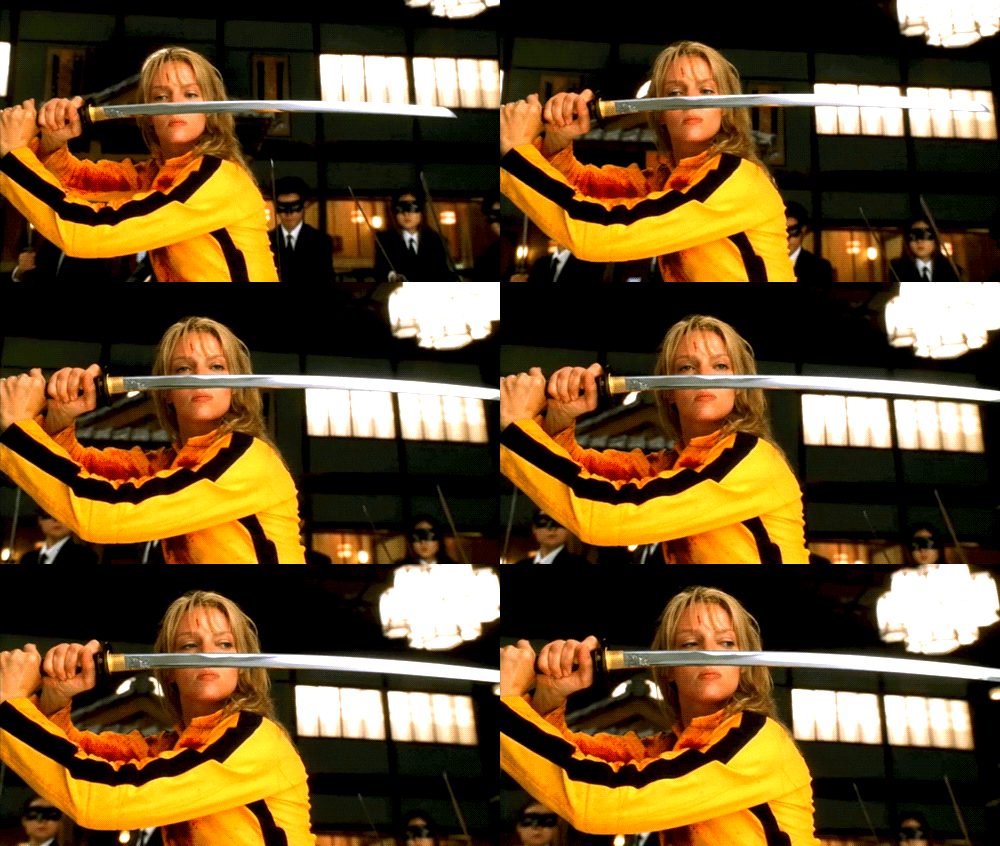
Allie is a rough scavenger. She talks back, is sarcastic, and wields a katana. She does have a nice side; teaching others to read, making sure Stick doesn't starve, and going out of her way to help even the people that hate her. She is definitely not passive and it is refreshing.

The Love Interest

I wasn't too attached to him. Everyone hates vampires without question, kind of like how everyone hates the pixies in Carrie Jone's Need series. You love someone, they hate what you are. At what point do you throw up your hands, call them a bigot, and tell them to save themselves? And Allie isn't a damsel in distress in this book. She has a sword and will kick butt. She does more than her share of saving others, all while hiding what she is.

Essay Topics

Discrimination (humans vs vampires OR vampires vs humans) would be a very easy one, and it can be paired with Wicked, Need, or pretty much any other YA paranormal book. You could also look at vampire depictions across different genres/publication dates/marketed audience. These vampires are ruthless monsters. Twilight, not so much. Interview with a vampire, they can be, but they are very Romanticized. Depending on the story, vampires represent many different types of real-life fears, and you can tie in some film clips, if you have to present the argument (the film rights have been sold, but we will probably have to wait a while before it is released).


Worst character award goes to:

Stick.

Morgan has his stick.


Rafiki has his stick.


This Stick, is not good.

Second to Stick in the worst character award:

Ruth.

Final Thoughts

An interesting mix of paranormal and dystopian fiction with a female protagonist that can hold her own and vampires that don't suck (har-har). Julie Kagawa is a popular YA author, so I see no reason to exclude this book from a YA section. I hope to alternate between this series and the Immortal Game series by Ann Aguirre.